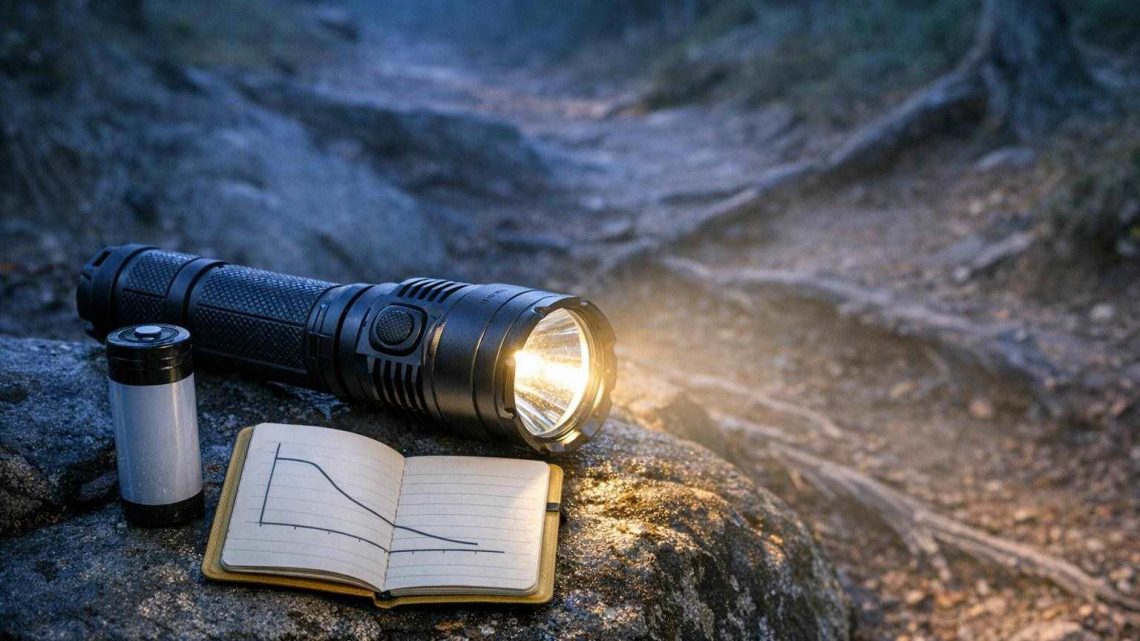
Comparing Flashlight Runtime Charts With Real Outdoor Use
October 11, 2026The graph and/or chart is of limited value in assessing experience on a trail and should be used only as a starting point. A measured value under ideal test conditions is of little value when recorded experience of real-life cold-weather use is considered. All lights drop in brightness over time. Some more than others. The factor that has the greatest influence on runtime is battery age and condition. Also, changes in brightness over time and many other factors, that experience on the trail reveals.
Read the chart as a set of conditions
The run-time chart published on the packaging is based on a specific test setup. That will include the use of specific batteries that have been fully charged for the test. It will also be based on the light having been set to a specific brightness and the chart will be stopped at a specific point. Even though the number on the packaging is accurate for the test conditions described above, it does not have to reflect the real world usage of the light.
Start with what the chart actually measures. Will the light continue to run until it eventually switches off in the dark or will it slowly get dimmer and be of less use to you before eventually switching off? Often a light will continue to operate for many hours after it has reached a level where you will no longer find it useful.
The shape of the curve down is more important than the last figure for a very long time at very low light levels. For path finding etc – reading maps etc – then it's the usable brightness for a period of time that is most important.
Do not treat figures read from different products as if they had been tested under the same conditions. Use the figures as references that can be more or less relevant depending on how close the test conditions are to the battery and to the running mode that you intend to use.
Separate brightness from useful endurance
Note that lumen runtime is a compromise between how bright a light can be and how long it will last on one set of batteries. So, a higher brightness is great for spotting a trail junction, identifying a distant object or getting through confusing sections of trail, but it also burns up the batteries faster and generates more heat. On the other hand, a lower brightness setting is typically more suitable for trail walking, for camp use, for reading and for travel, because it doesn't consume as much power and doesn't generate as much heat.
To decide how much power you need, assess the lighting needs of your trip. The power needed for route finding and occasional map reading will be different than that for long periods of walking through dull industrial-type landscapes. And the power required for finding your way through dense tangle-covered single track, with snow, and at night is obviously greater.
Reading a flashlights run-time chart for trail running or hiking needs to include more than one setting. You need to read in the modes you will use for running (normal), for short episodes of higher need (_extra) and for emergency / very low light situations (low). Typically only the most powerful setting is listed, but that does not necessarily mean it is the best for your needs.
Be careful not to fall into the trap of selecting a flashlight that is powerful enough but too cumbersome to use on your trips. If you have to change modes too often or the light is too harsh or just does not work for you in certain situations then it is not the flashlight for you.
Account for batteries, temperature, and storage
Battery life of a flashlight depends not only on the light itself, but on the batteries as well. The battery type, charge level, age, storage and contact to terminals all can have big effects on runtime. This is why batteries that have been stored for a long time, carried loose in a damp pocket, or have been subjected to extreme temperatures, should not be treated as freshly bought units and used for testing.
Also be aware of how cold weather can affect your batteries. Less energy is released to power your light, and this difference may become more apparent as you increase the output of your light. Always store your spare batteries in a protected environment, away from metals (such as flashlights), and ensure that you read and follow the instructions from the manufacturer of both your batteries and light. Do not mix and match different batteries.
Check the battery holder and the entry point of the battery for signs of dampness and for dirt. Be sure the lamp's switch cannot be triggered accidentally in the pack. If you have to store spare batteries for a long time, make sure you have a large supply of the correct type and that they are all protected from damage in the same way and easily identifiable in the dark.
Store the light and batteries for extended periods of time with no use just as the manufacturer recommends. Do not store wet light equipment. Open up wet storage equipment to allow it to dry. Do not put a wet light into a sealed storage pouch.
Build a trip estimate with a reserve
Divide the intended use of the light into tasks (such as walking, examining an object, navigating etc.). For each task, estimate the length of time the light will be needed. Also, include additional time to find a lost item, to wait for others, to navigate around an obstacle etc. – and to return to the campsite after a longer day.
Then add some reserve time. How much reserve time is needed to complete your trip depends on many factors like the route taken, weather conditions, distance to a shelter, availability of a second light source and how much trouble would be caused by reaching your destination late at night.
Note how long you think your movements will last, and make a table of tasks you'll be carrying out and their estimated duration. Remember to add some reserve, which will depend upon the specific nature of your trip, and list the places where you can recharge, swap batteries or retrieve an extra light in case of need. Even if a light seems sufficient to last for the duration of a short trip, it's good to test it out in preparation for longer ventures.
A simple pre-trip checklist can include:
– Battery charged, fresh and fitted correctly.
– Test every function and ensure that the switch functions in all modes.
– Inspect the lens, body, threads, seals and battery contacts for any signs of wear and tear.
– Pack a spare (protected) battery for the flashlight or a separate backup light when the trip warrants it.
– Make sure the light is easily accessible. Do not store it in the bottom of your pack, in your pocket or under your clothing and food.
Verify performance before relying on it
This test does not have to be long but it is better to test under the same conditions as you would use the light on your trip, with the same type and quantity of batteries, and on the same mode as your normal use. It is also good to test the light after some time of storage, and with different batteries.
Compare how the light will look like at typical walking distances instead of just against a nearby wall. Will there be too much glare? Will there be enough peripheral vision? Will it be unfairly dim in some parts and very bright in others? Will there be hot spots that will make it harder to see to step on different surfaces of ground? Will there be special uses for special modes, and will you remember to use them for those special uses?
Note the battery type(s), the preferred mode(s), and the point at which you would replace the batteries or recharge them for each light on your kit list. This will enable you to easily test the light as you retrieve it from your store and verify that it is functioning as you had prior confidence that it was. By doing so you will able to immediately identify any deterioration caused by aging batteries, dirty contacts or a failing switch etc.
In summary, charts are useful to compare products. The real performance of a flashlight has to be checked in practical situations and taking account of the tasks to be performed. Furthermore, one has to think of the power source, and allow for sufficient margin for unexpected situations on the actual trip.